More charity opportunities.Â
Friends to Seniors site matches stitchers to needs from the elderly in their area. According to the literature they are branching out to other areas. There are several different ways to help. Check them out!!!
Charts, patterns and everything needlepoint
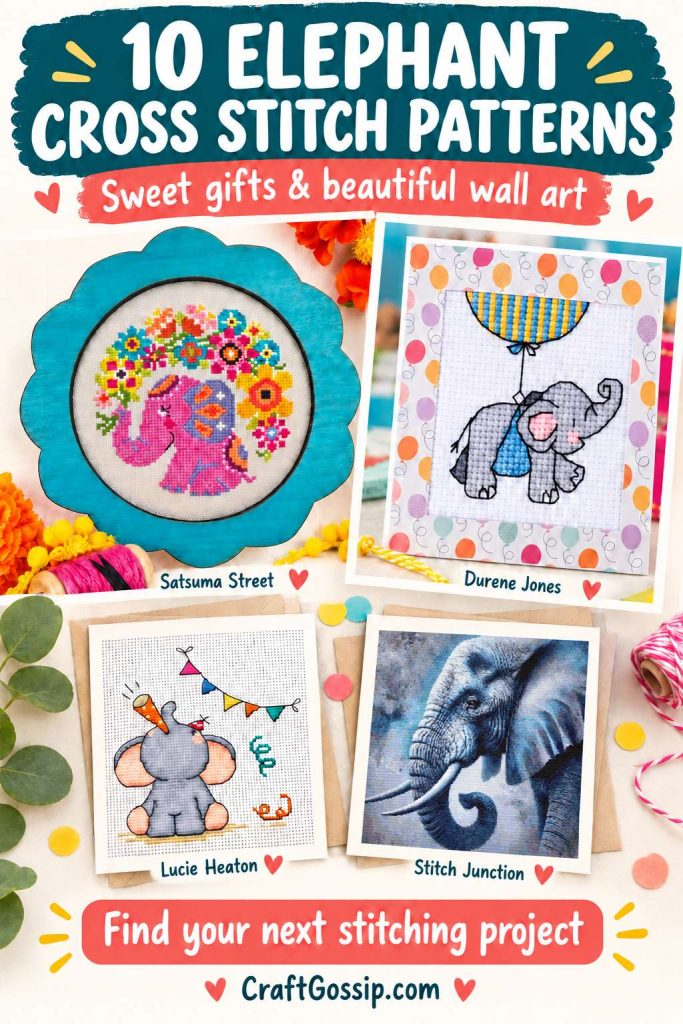
There’s something about an elephant that makes it almost impossible to resist in stitched form. Perhaps it’s those oversized ears, or the way a little curled trunk can give a handful of stitches so much personality. Put one on a handmade card and I’m interested. Add flowers or a tiny nursery setting and suddenly I’m checking whether I have enough grey thread.
But elephant cross stitch patterns aren’t all pastel baby gifts. There are cheerful little motifs, colourful pincushions and detailed wildlife designs that deserve a proper place on the wall. That variety makes them lovely projects for everyone from a returning stitcher to someone who enjoys settling into a substantial piece.
I’ve gathered ten individual patterns, including free downloads and paid charts. There are smaller projects for a manageable finish, nursery keepsakes to give with love, and a couple of bigger undertakings for anyone whose idea of relaxation involves a well-stocked floss organiser.
If you have a small piece of Aida tucked away because it was “too useful to throw out,” this might be its moment. The Mini Elephant Cross Stitch Pattern from Craft with Cartwright is a free design that the designer suggests using for cards, gift tags and covered buttons. Its miniature format makes it an appealing starting point for beginners or anyone returning to counted stitching. I especially like the covered-button idea—a little elephant could make an ordinary accessory feel rather special.
An elephant taking flight is exactly the sort of cheerful nonsense that belongs on a handmade birthday card. The free Floating Elephant Cross Stitch Pattern by Durene Jones uses whole cross stitches and backstitch, and the publisher recommends it for beginners wanting a smaller project. It is shown on white 14-count Aida, with an estimated stitching time of three to four hours, although your own pace may vary. Mount it in a card or frame it as a little nursery keepsake.
For an elephant with a playful, modern feel, the Flower Friends: Ellie Cross Stitch Pattern is a lovely choice. This paid PDF chart measures 66 by 65 stitches and finishes at approximately 4¾ inches square on 14-count Aida or 28-count fabric worked over two threads. The suggested palette uses 17 shades of Cosmo floss, giving you a compact project with plenty of colour to enjoy. I’d choose this for someone comfortable following a chart who wants a cheerful framed gift without committing to an enormous piece.
A stitched birthday card has a way of staying on display long after the wrapping paper has disappeared. The Elephant Birthday Cards Cross Stitch Pattern by Lucie Heaton includes four party-themed elephant designs in one paid PDF. Each measures approximately 65 by 70 stitches and uses whole cross stitch with backstitch, making this a useful next step for a beginner ready to practise outlined details. These would suit children’s birthdays beautifully, although I know a few grown-up elephant lovers who would be delighted with one too.
Some handmade gifts are intended to be kept, and a stitched nursery picture certainly falls into that category. The Baby Elephant Nursery Cross Stitch Pattern from SevendreamsShop is a paid Etsy download intended for nursery décor and baby shower gifts. It includes colour-and-symbol charts, black-and-white symbol charts and a floss list, so you can choose the chart format you find easiest to follow. I’d consider this for a stitcher already comfortable reading patterns, and check the listing’s dimensions against your intended frame before gathering supplies.
Flowers and elephants make a surprisingly charming combination. The Forget-Me-Nots Cross Stitch Pattern by Ink Circles features an elephant carrying flowers in a compact 58-by-58-stitch design. The model uses 32-count linen and a ThreadworX palette, with a DMC conversion supplied, giving stitchers some flexibility when gathering threads. This paid chart would be a thoughtful friendship gift, particularly for someone who enjoys smaller counted projects with a slightly different character.
For anyone who likes their stitching to become something useful, a pincushion is a satisfying change from another frame. The Elephant Biscornu Cross Stitch Pattern by Satsuma Street uses colourful DMC threads, with two 72-by-72-stitch panels forming the finished biscornu. The model is stitched over two threads on 28-count linen, and the assembled pincushion measures approximately 4½ inches across by 2 inches high. I’d save this paid chart for a confident beginner or intermediate maker who fancies combining counted stitching with a little construction work.
If your elephant enthusiast prefers wildlife to nursery décor, this is a lovely direction to take. The African Savanna Elephant Cross Stitch Pattern belongs to Lindy Stitches’ Endangered Species Club and features an elephant surrounded by African-themed flora. At 107 by 107 stitches, it offers more room for detail than the miniature designs while remaining a manageable square composition. I’d suggest this paid pattern for someone with a little counted-stitch experience who wants a nature-inspired piece to frame.
Grey isn’t the only way to stitch an elephant, and this portrait makes a strong case for reaching into the blue section of your thread box. The Elephant Cross Stitch Pattern from Stitch Junction features textured skin, curved tusks and expressive shading in a 200-by-200-stitch design using 25 DMC colours. The paid PDF includes colour and black-and-white symbol charts, plus a Pattern Keeper compatible file. I’d treat this as a longer project for an experienced stitcher who enjoys following subtle changes in shade and watching a detailed portrait emerge.
There is always room for one ambitious project—the sort that gets its own storage bag and a very optimistic completion date. The Elephant Cross Stitch Pattern from Unconventional X Stitch is a full-coverage design based on artwork by David Lozeau, measuring 570 by 290 stitches and using 100 DMC colours. Although it uses full cross stitches throughout, its scale and colour count make this a substantial undertaking best suited to experienced stitchers. This paid digital chart is the choice for someone who wants a statement piece and enjoys the process as much as the eventual finish.
My first suggestion is to choose the project’s destination before choosing the chart. A birthday card, a nursery picture and a detailed wall hanging ask very different things of your stitching time. It is much easier to stay enthusiastic when the project fits both the occasion and the amount of counting you actually enjoy.
Look at the stitch dimensions, colour list and finishing requirements before cutting your fabric. Leave enough spare fabric around the design for your hoop and chosen finish, and remember that a pattern purchase usually means the chart rather than a complete kit.
If you’re still finding your feet with needlework terminology, our guide to What’s the Difference Between Cross Stitch, Blackwork, Redwork, and Surface Embroidery? explains how the different styles work. It is useful when shopping, because an elephant embroidery design isn’t necessarily a counted cross stitch chart.
I’d start with one of the smaller elephants if you’re making a gift with a deadline. There’s plenty of charm in a little stitched card, and finishing something lovely is a very good excuse to choose your next pattern. Though perhaps count the grey skeins first.